
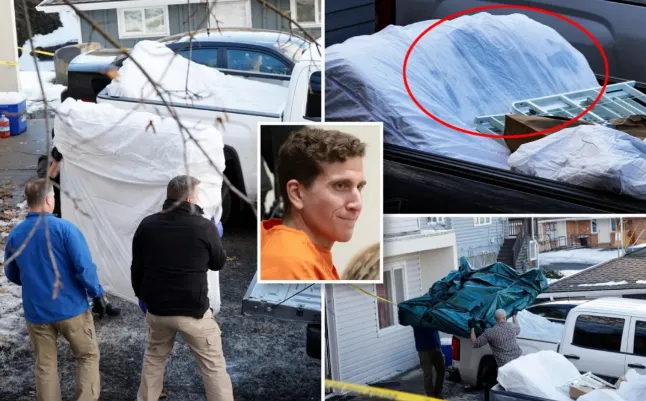
MOSCOW, Idaho — A large truck and uniformed staff were seen Tuesday, June 27, at the three-story home where four University of Idaho students were brutally murdered last November. The cleaning company tasked with removing personal belongings from the house, which now belongs to the University of Idaho, is preparing the property for demolition this summer — a final step in a tragedy that has left a community reeling.
The victims — Kaylee Goncalves, Madison Mogen, Xana Kernodle, and Ethan Chapin — were found dead in the home on January 3, 2023, an event that shocked not only Moscow but the nation. Authorities have described the murders as intentional, violent, and deeply senseless, sparking ongoing grief and calls for justice.
On Tuesday, as the cleanup began, the alleged perpetrator, Bryan Kohberger, appeared in court. The hearing coincided with a notice filed by Latah County Prosecutor Bill Thompson, who declared his intent to seek the
death penalty against Kohberger, citing five “aggravating circumstances” that could justify capital punishment.
The home on Fuller Street, where the murders occurred, is more than just a building; it is a haunting symbol of loss. The cleaning company’s work is painstaking, focused on removing personal belongings for the victims’ families. According to a spokesperson, the process may take several weeks.
“We are beginning remediation with the removal of all the personal items for the families to receive, as they wish,” the company said in a statement to CourtTV. “This will take several weeks. No date set for demolition.”
For the families, every item removed from the home represents memories of the lives stolen, and the process has been described as both cathartic and agonizing. Each photograph, textbook, or personal belonging recovered is a reminder of the young lives cut tragically short.
Courtroom Tensions Escalate
The day of the cleanup coincided with a tense court appearance for Kohberger in Latah County Court. Judge John Judge presided over arguments on several defense motions, including motions to compel evidence and discovery related to the murder investigation.
Kohberger’s defense team requested training records for three police officers who interviewed “critical” witnesses, background on the FBI team leading the probe, and details about the tip that led to the search for Kohberger’s white Hyundai and cellphone records referenced in the probable cause affidavit.
“There is a heightened standard now that the State has announced its intent to seek the death penalty … and these are very relevant pieces of information,” the defense said. Prosecutors, however, argued that most of the materials had already been made available, and that releasing training records could set an unfavorable precedent for future cases.
Judge Judge indicated that a written ruling specifying what evidence the prosecution must turn over would be issued by July 14.
The Victims’ Families and the Weight of Loss
The victims, all University of Idaho students, were just beginning their adult lives. Ethan Chapin, 20; Madison Mogen, 21; Xana Kernodle, 20; and Kaylee Goncalves, 21 were friends, classmates, and young adults full of potential, whose lives ended abruptly and violently.
For their families, the legal proceedings are intertwined with grief, anger, and the painstaking task of trying to reclaim what little semblance of normalcy remains. Every update from the courtroom and every item removed from the home is a reminder of the void left behind.
CourtTV reports that the cleaning staff has been coordinating closely with family members, ensuring that personal belongings are returned before demolition. It is a meticulous, emotionally fraught process — one that underscores the permanence of the loss and the human need for connection, even amid tragedy.
The Legal Battle Ahead
Kohberger, who has not entered a plea for the murder charges, had a not-guilty plea entered on his behalf at a prior arraignment. He faces four counts of first-degree murder and one count of burglary. His trial is currently scheduled for
October 2, though that date is expected to shift due to ongoing defense motions.
Among the motions, a key motion to compel seeks access to all information regarding the
genetic genealogy and DNA evidence linking Kohberger to the murders. The defense argues that information about the scientists who conducted the testing, and how the investigation initially zeroed in on Kohberger, is critical to building a case.
Prosecutors countered that much of the requested information had already been disclosed and that the release of certain records could hinder law enforcement operations in future cases.