The Little Girl Who Fought the Unthinkable — The Story of Baby Heidi’s Brave Heart
The world can change in a heartbeat.
For one young Australian couple, it changed forever when their baby girl — a tiny, smiling fighter namedHeidi Claire Smith — was just two weeks old.
What began as a hopeful beginning quickly turned into a journey that would test every limit of love, courage, and faith.
Fourteen months.
That’s all the time they had.
But in those fourteen months, Heidi would show the kind of strength that most people spend a lifetime trying to find.
This is her story — a story not just of tragedy, but of light.

The Beginning of a Miracle
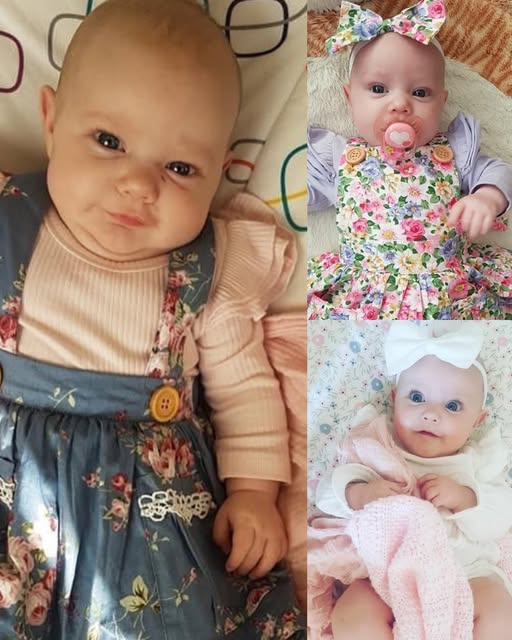
Heidi came into the world like a burst of sunshine — soft golden hair, bright curious eyes, and a laugh that sounded like a melody.
Her parents still remember the first time she gripped their fingers — tiny hands holding on with surprising strength.
“She was perfect,” her mother later said. “Absolutely perfect.”
But two weeks after her birth, that perfection began to unravel.
Doctors noticed something unusual on her lower back — a small lump, soft but visible.
After several scans and long, silent consultations, the diagnosis came: Lipomyelomeningocele, a rare form of spina bifida.
It meant that part of her spinal cord was tethered — trapped by a fatty mass — and as she grew, it would stretch unnaturally, threatening to damage her nerves and paralyze her lower body.

For most parents, hearing “spina bifida” would have been devastating.
For Heidi’s parents, it was the start of a mission.
They learned medical terms, consulted surgeons, and surrounded their baby with love.
At nine months old, Heidi underwent her first major surgery — a procedure to detether her spinal cord and remove the lipoma.
It was delicate, dangerous, and daunting.
But Heidi came through it like a champion.
“She woke up smiling,” her father said. “Like she knew she’d won.”
For a brief moment, it seemed like the worst was behind them.

The Change No One Saw Coming
Just after her first birthday, Heidi’s parents noticed something strange.
One morning, she woke up with her head tilted slightly to one side.
At first, they thought it might be stiffness — maybe she’d slept funny.
But as the days passed, the tilt grew worse.
She became unusually tired.
She began vomiting daily.
She stopped walking, then crawling.
And soon, the cheerful little girl who used to chase bubbles and giggle at her reflection could barely stay awake for more than a few hours.
Her parents knew something was wrong — something more than post-surgery recovery.
They begged for answers, demanded an MRI.
When the results came back, their world shattered.

The Diagnosis That Broke Every Rule of Fairness
The scans showed a massive lesion on the posterior fossa — a large section at the base of the brain that controls balance, coordination, and vital functions.
The doctors’ faces said what their words couldn’t.
Heidi had ATRT — Atypical Teratoid Rhabdoid Tumor, one of the rarest and most aggressive forms of childhood brain cancer known to medicine.
Most children with ATRT don’t survive.
Even with immediate, high-dose treatment, the survival rate was only 40%, and that was the “best case.”
Her parents listened as doctors outlined a year-long plan of chemotherapy, radiation, and direct medication delivered through aRickham reservoir inserted into her skull.
Each treatment carried its own risks — infection, bleeding, neurological damage.
But there was no hesitation.
“If there’s even a chance,” her father said, “we’ll take it.”

The Fight That Defined Her
The next few months became a blur of hospital corridors, sterile rooms, and whispered prayers.
Heidi endured more procedures than most adults do in a lifetime — central lines, lumbar punctures, multiple rounds of chemo, and injections directly into her brain.
Her parents decorated her hospital room with fairy lights and stuffed animals.
They read her stories about brave girls and magic kingdoms.
They refused to let the machines, the tubes, and the fear define her world.
“She smiled even when she was sick,” her mother said. “She’d hold our faces and giggle. She made everyone around her stronger.”
Nurses began calling her Little Miss Sunshine.
Doctors marveled at her resilience.
Even on days when her small body trembled from medication, she’d reach out for her toy bunny and flash that tiny, unstoppable grin.

Hope in the Middle of the Storm
For a while, it seemed like the treatments might be working.
Her scans showed signs of stabilization.
Her parents dared to dream — dared to imagine birthdays, playgrounds, first days of school.
But ATRT is relentless.
It hides, it waits, and when it returns, it comes back with vengeance.
By early June 2020, Heidi’s condition began to deteriorate again.
She developed fevers, her heart rate fluctuated, and her breathing became labored.
Doctors suspected infection — a common but deadly risk in children with central lines.
Within hours, she was in septic shock.
Her organs began to fail.
Machines worked overtime to keep her alive.
Her parents stood by her bedside, whispering words of love, their hands on her tiny chest, feeling each faint heartbeat.

The Final Goodbye
On June 19, 2020, at just 14 months old, Heidi’s fight came to an end.
Her parents were with her — holding her as the machines went silent, as the beeping faded into stillness.
“She looked peaceful,” her mother said softly. “Like she’d fallen asleep in our arms.”
The nurses cried.
The doctors stood in silence.
Because in that moment, everyone knew they had witnessed something sacred — the courage of a child whose spirit refused to be broken.

The Aftermath of a Miracle
When news of Heidi’s passing spread, messages of grief and support poured in from around the world.
Strangers who had followed her journey online shared stories of how she had inspired them to be better parents, better people, better believers.
Her family turned their pain into purpose.
They began advocating for awareness and research into ATRT and childhood brain cancers, hoping that someday no other family would have to endure the same heartbreak.
In her memory, they created a fund to support pediatric oncology wards — filling them with toys, blankets, and comfort items to bring warmth to children facing their own battles.
Because that’s what Heidi had done all along — she brought warmth to every room she entered.

The Legacy of a Fourteen-Month Warrior
Heidi’s short life reminds us that time isn’t measured in years, but in impact.
She changed people.
She softened hearts, deepened faith, and reminded everyone who heard her story that even in the darkest circumstances, love can still shine brighter than fear.
Her parents say that sometimes, when the wind blows through their garden, they hear her laugh — faint but unmistakable.
Her favorite toy bunny still sits on her crib, untouched, waiting.
“She taught us what bravery really means,” her father said. “It’s not about winning every battle. It’s about facing each day with love.”

A Lesson in Courage
Medical journals describe ATRT as “aggressive and unpredictable.”
But if you ask the people who knew Heidi, they’ll use a different word: extraordinary.
She endured everything — surgeries, needles, pain — with grace that defied comprehension.
Every photo of her shows the same thing: a smile that refused to fade.
And maybe that’s the lesson she leaves behind.
That strength isn’t the absence of fear — it’s love that refuses to let fear win.

The Girl Who Became a Star
On the night she passed, her parents stepped outside the hospital and looked up at the sky.
A single star seemed to shine brighter than the rest.
“Look,” her mother whispered, “she made it.”
Since then, they’ve called it Heidi’s Star.
It’s the one that appears just after sunset, low and golden — the kind that seems to pulse like a heartbeat.
To them, it’s a sign.
A reminder that their little girl didn’t lose.
She simply moved her light somewhere higher.

The Story That Must Be Told
Heidi’s journey is not an easy story to read — but it’s one that must be told.
Because behind every statistic is a face, a family, a heartbeat that mattered.
Childhood cancer remains one of the least-funded areas of medical research, despite being one of the most devastating.
Heidi’s story has become a rallying cry for change — for awareness, for compassion, for better care.
Her parents continue to speak her name, to share her photos, to make sure that the world remembers not just how she died, but how she lived.
“She made every moment count,” her mother said. “Even in pain, she loved. She laughed. She gave us everything she had.”
The Heart That Still Beats in Memory
Every June, her family gathers to celebrate her life — not with tears, but with laughter, balloons, and music.
They release pink and white balloons into the sky, each carrying a message of love.
Children who never met her draw pictures of her playing in heaven, free of tubes and pain, surrounded by flowers and sunshine.
And maybe that’s exactly where she is.
Because somewhere beyond all of this — beyond the hospitals, the surgeries, and the grief — there’s a little girl running barefoot through fields of light, laughing that same musical laugh that once filled her parents’ hearts.
Her body is gone.
But her story — her courage — is eternal.