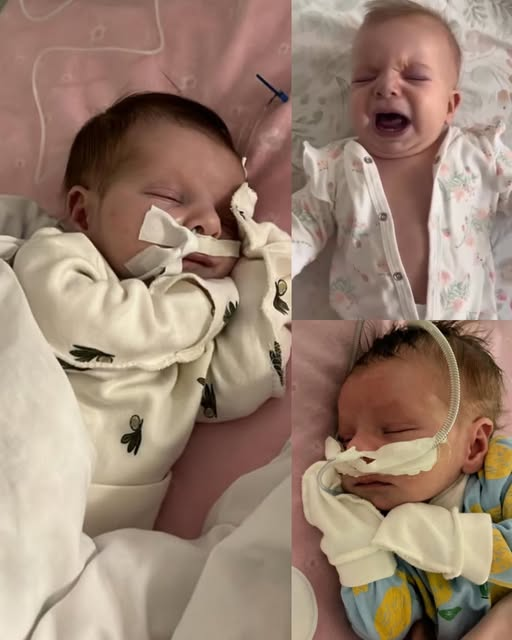
At first glance, she looks like any other baby — soft cheeks, curious eyes, tiny fingers that curl instinctively around her mother’s thumb. But behind that fragile beauty lies a devastating truth:Safia was born with only half a heart.
She is just five months old, yet every beat of her heart is a fight for survival. Every breath, a borrowed miracle.
And now, her family is racing against time — and across continents — to save her life.

A Tiny Heart With a Giant Battle
Safia was born with one of the most severe congenital heart defects known to medicine:Hypoplastic Left Heart Syndrome (HLHS).
In simple terms, this means the entire left side of her heart — the part responsible for pumping oxygen-rich blood to her body — never fully developed.
The left ventricle, the mitral valve, and the aortic valve — all are severely underdeveloped.

It’s a diagnosis that steals the breath of every parent who hears it.
Doctors in Russia told her family what no parent should ever have to hear: “There’s nothing more we can do.”
But halfway across the world, in a hospital in Boston, a glimmer of hope appeared.

The Heart That Wasn’t Supposed to Beat
When Safia was born, her parents were told she might not make it through the first few days.
Her body struggled to circulate blood. Her skin turned pale, then blue. Machines were hooked up, lines inserted, alarms echoing in the sterile room that would become her first home.
But Safia was not ready to leave this world.

She defied the odds, clinging to life with the strength only a child can summon.
Even as her heart pumped at half capacity, her spirit refused to quit.
Her doctors stabilized her, but they were honest: this was only the beginning of a long, uncertain road.

A Diagnosis Too Complex for Home
In Russia, doctors tried to manage her condition, but HLHS is one of the most complex heart defects in existence.
To survive, most children need a series of three surgeries performed at specific stages of early life — procedures that can only be done at a handful of hospitals worldwide.
But in Safia’s case, things were even more complicated.

Scar tissue had formed around the underdeveloped side of her heart, limiting the possibility of future surgical correction.
Her doctors explained that this scar tissue needed to be carefully removed to give her remaining heart chambers a chance to grow. Without that, her condition would become terminal.
The sad truth? No hospital in Russia had the capacity to perform such a delicate, specialized operation.
But one hospital in the United States did.

A Miracle in Boston
AtBoston Children’s Hospital, one of the world’s leading centers for pediatric cardiac surgery, a team of specialists reviewed Safia’s medical files.
And for the first time, her parents heard the words they had been praying for:
“There is hope.”

The team in Boston offered a unique and highly advanced procedure — a surgery designed to remove the fibrotic (scarred) tissue constricting her tiny heart.
If successful, the operation could allow her left ventricle — currently dormant and underdeveloped — to grow stronger as she does.
This would open the door to future surgeries — potentially transforming her condition from “half a heart” to a functioning, near-complete heart.
It was a medical breakthrough — and Safia’s only chance to live a normal life.

The Window of Time
The problem? Time.
Safia’s heart is deteriorating every week.
Her oxygen levels are dropping. Her tiny body tires quickly, her lips sometimes turning blue when she cries.
The doctors in Boston warned that the operation must happen soon — before irreversible damage sets in.

But getting her there is no small task.
Her family faces not only medical barriers, but financial ones.
Between airfare, hospital admission, surgical costs, post-operative care, and weeks of observation, the expenses are staggering — far beyond what any ordinary family can afford.
And so, they have turned to the world for help.

A Family’s Plea
Safia’s parents have begun sharing her story online, hoping to reach compassionate hearts around the globe.
They post photos of their daughter — bundled in soft blankets, connected to monitors, eyes wide open and filled with life.
Each post carries the same message: “Please help us save our baby.”
It’s not just a campaign. It’s a cry for help — a plea from two parents watching the clock tick down on their child’s life.
For them, every donation, every share, every kind word is more than support — it’s oxygen for hope.

The Science and the Soul
For doctors, Safia’s case is a challenge of precision and timing.
For her parents, it’s a test of faith.
In Boston, the surgical team is prepared to perform something that borders on miraculous — a multi-stage reconstructive procedure that will attempt to reshape the malformed portions of her heart.

In essence, they are not just trying to fix a defect — they are trying to teach a heart to grow.
If successful, Safia may one day live without constant oxygen, without monitors, without the blue tinge that marks every breath of a child with HLHS.
She might learn to crawl, to run, to laugh without gasping for air.
She might grow up.

A Half-Hearted Beginning — But Not a Half-Lived Life
Safia’s name means “pure” — a fitting name for a soul who has known only hospital walls and love in its truest, most desperate form.
Her mother whispers to her every night, “Hold on, my love. We’re coming with help.”
Her father spends hours on calls with hospitals, embassies, charities — anyone who might have an answer.
They have already sold everything they can.
Now, their only wealth is faith.
Faith that somewhere, someone will see their daughter’s face and decide she deserves a chance to live.

The Global Fight for a Single Heartbeat
Stories like Safia’s are becoming more common as medicine advances faster than accessibility.
Around the world, children born with congenital heart defects often depend on international cooperation, funding, and human compassion to survive.
Safia’s case highlights the heartbreaking reality: sometimes, life isn’t lost to disease — it’s lost to geography.
In Boston, she has a 70% chance of survival.
In Russia, without the surgery, her chances drop to near zero.
That difference — that distance — is the line between life and death.

The Promise of Tomorrow
If Safia reaches Boston, she will undergo one of the most delicate procedures in pediatric cardiology — a surgery that could last up to ten hours.
Afterward, she’ll remain in intensive care for weeks.
The path will be long — filled with pain, recovery, and more surgeries down the road.

But for the first time, there will be a path at all.
Doctors believe that if her heart responds well, Safia could one day walk, play, and live a near-normal life.
They can’t promise forever — but they can promise a chance.
And for her parents, that’s everything.

A Call to Humanity
Safia’s fight is not just medical — it’s deeply human.
It’s a story about how fragile life can be, and how powerful love can become when faced with losing it.
No one chooses to be born with half a heart.
But perhaps, it takes a community of whole hearts to save one that isn’t.

Her family doesn’t ask for miracles.
They ask for help — for one more breath, one more heartbeat, one more tomorrow.
Because every child deserves the chance to grow up.
Even one born with half a heart.