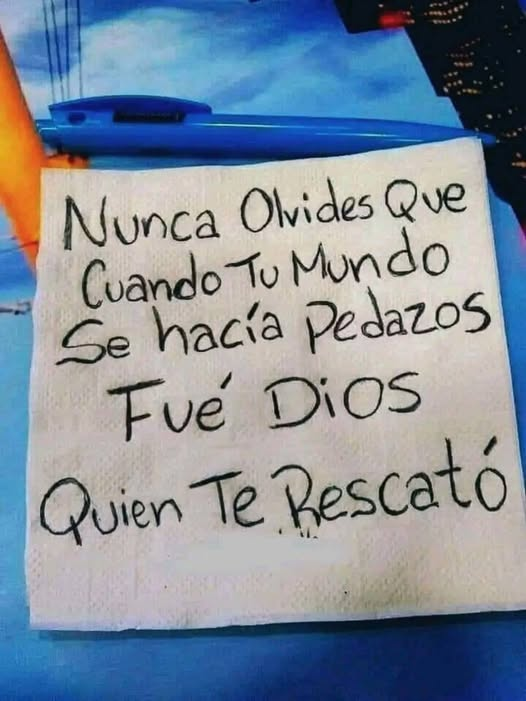
This image portrays a simple yet profoundly moving message written by hand on a napkin, accompanied by a blue pen resting above it. The text, in Spanish, reads: “Nunca olvides que cuando tu mundo se hacía pedazos fue Dios quien te rescató” — which translates to, “Never forget that when your world was falling apart, it was God who rescued you.” Though the words are penned on an ordinary piece of paper, their emotional weight and spiritual depth transform this image into something far greater than its simplicity suggests.
At first glance, the image seems casual — just a handwritten note captured on a table — yet it carries the intimacy and sincerity of a personal revelation. The handwriting feels authentic, imperfect, and human, reflecting the rawness of someone who has experienced pain and found hope through faith. The use of the word “rescató” (rescued) is particularly striking; it evokes not just salvation, but deliverance from despair, as if the writer had been lost in darkness and found light again through divine intervention.
The message speaks to universal human experiences: suffering, brokenness, and the search for meaning amid chaos. Everyone, at some point, faces moments when life feels shattered — when dreams collapse, relationships falter, or personal struggles seem too heavy to bear. In those moments, this note reminds the reader that faith can be an anchor. The idea that God was present during one’s lowest moments offers both comfort and perspective. It is not merely about religious belief, but about the reassurance that there is a higher force capable of turning pain into strength and despair into renewal.
The phrase “Nunca olvides” (“Never forget”) carries a tone of both warning and encouragement. It urges the reader not to take their survival or recovery for granted. Gratitude, in this context, becomes a spiritual practice — remembering who lifted you up when you were down keeps humility and faith alive. In a world where people often forget the source of their strength once the storm passes, this message calls for reflection and acknowledgment.
Visually, the blue pen lying across the napkin adds to the scene’s quiet significance. It symbolizes expression and communication — the act of turning thought into word, and word into testimony. The napkin itself, a disposable everyday object, contrasts beautifully with the eternal nature of the message it carries. It suggests that inspiration and truth can appear in the most ordinary places, not only in sacred spaces or grand gestures.
Beyond its religious connotation, the message can also be interpreted metaphorically. “God” here can represent faith, love, or even the inner resilience that pulls a person out of despair. Whether one attributes their recovery to divine grace, destiny, or personal willpower, the essence remains the same: when everything seemed lost, something greater than fear intervened.
Ultimately, this image serves as a quiet testimony of hope. It reminds us that miracles often occur not as thunderous acts, but as gentle rescues — moments when we are lifted from our lowest depths and given the strength to continue. The handwritten note is more than ink on paper; it is a heartfelt declaration that even in the darkest hour, light finds a way to reach us.