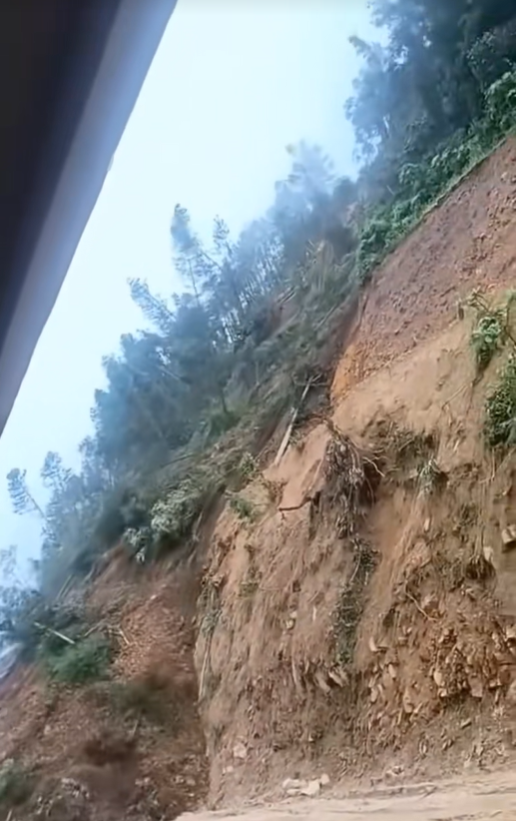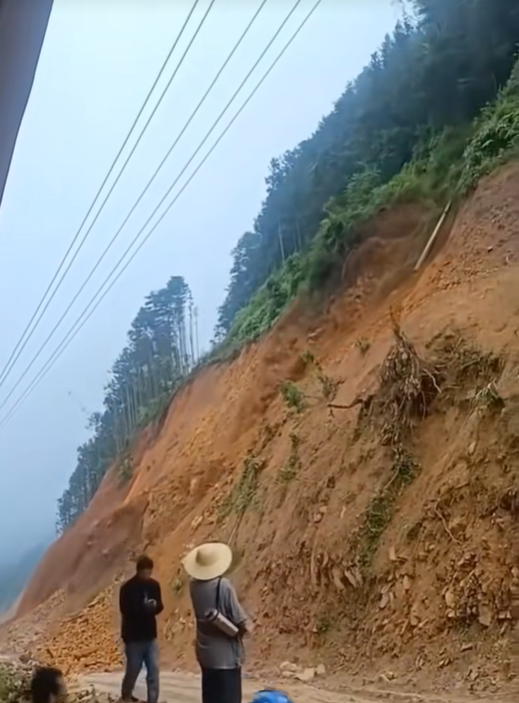
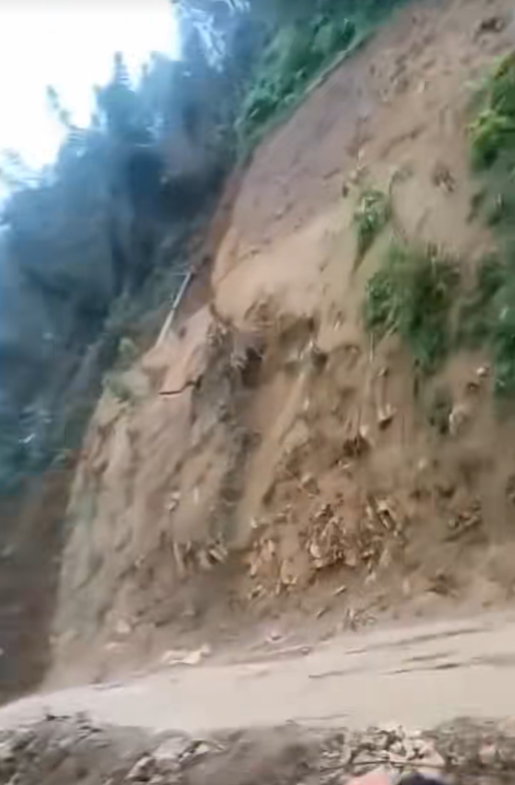
This image captures a dramatic and alarming moment of a landslide in progress on a steep, deforested hillside. The earth, once held in place by trees and vegetation, is collapsing under its own weight, sending soil, rocks, and uprooted trees cascading down toward the road below. Several onlookers stand at a distance, watching the unfolding event with caution and disbelief. Their posture and expressions suggest both fear and helplessness, as the sheer power of nature reveals itself before their eyes. The dense fog and mist in the background add a somber tone, emphasizing the danger and uncertainty of the situation.
The exposed slope tells a story of environmental vulnerability. The reddish-brown soil indicates a lack of vegetation and moisture retention, common in areas where trees have been cleared for agriculture, road construction, or logging. Without the stabilizing network of roots, the hillside has lost its structural integrity. When heavy rains soak into the loosened earth, the weight of the water and the pull of gravity combine to trigger a landslide. The presence of power lines overhead adds another layer of risk — a potential hazard if the falling debris brings them down.
The people in the image appear small against the massive wall of earth, underscoring humanity’s fragility when faced with natural forces. One man, wearing a wide-brimmed straw hat and carrying a backpack, stands close to the scene, perhaps assessing the damage or recording it. Another person further down the slope seems to be moving cautiously away. Their stillness contrasts sharply with the motion of the falling soil, creating a tension between human observation and nature’s uncontrollable power.
Landslides like this one are common in mountainous and hilly regions around the world, particularly in places with a combination of deforestation, poor drainage, and unregulated land use. They can bury roads, destroy homes, and block rivers, leading to devastating secondary effects like flooding. The fact that people are standing nearby suggests that this area might be a community or a roadway vital to local transportation — a place where people must take risks just to continue their daily lives.
From a geological perspective, the landslide represents the natural process of erosion accelerated by human activity. Over centuries, slopes naturally shift and reshape through weathering, but when humans interfere — cutting into hillsides, removing vegetation, or diverting water — the pace of change becomes dangerously fast. The scene in this image could very well have been prevented through proper slope management, reforestation, or the construction of retaining walls and drainage systems. Unfortunately, such measures are often neglected until disaster strikes.
Emotionally, this photograph evokes both awe and unease. The towering slope and the exposed layers of earth serve as a visual reminder of how interconnected ecosystems truly are. The trees at the top — still standing but precariously close to the edge — symbolize the last line between stability and collapse. Once they fall, the slope may erode even further, continuing a cycle of environmental degradation.
Ultimately, this image is a warning — not only about the immediate danger of landslides but also about the long-term consequences of neglecting environmental stewardship. It captures a moment where human life and natural forces meet in stark contrast: one fragile, the other unstoppable. In that fleeting instant, the onlookers stand as silent witnesses to nature’s immense power and the high price of imbalance between progress and preservation.